
Showing posts with label living. Show all posts
Showing posts with label living. Show all posts
Monday, October 27, 2014
Back to America
I woke up at a quarter to six in a half empty room. Boxes were stacked in the corners, beer glasses from last night cluttered the place up, and various personal items lay in a semicircle around a number of packed bags. I had had a bunch of friends over just five hours ago, and the combination of packing, reorganizing, and hosting, along with Roman and Talia's yet-unpacked boxes being piled everywhere has left the apartment as an almost comical disaster. I got out of bed. After a few minutes of orienting myself to what was happening today, I threw on a swimsuit and set out along Herzl, then up past the back of the Shuk, and up the tayellet aside the beach.
When I got to the beach lookout by Bograshov I stopped. A teenage girl in army briefs with a gun slung over her shoulder showed up at the same lookout, leaned against the banister ten meters away from me, and turned her gaze to a troupe of 10 or so young guys training on the sand for army recruitment. The moment struck me as kind of picturesque, and I wished I had a camera. Unfortunately I didn’t. The shouts of the youths barely filtered through the quiet roar of the sea, and there was no other noise to be heard.
Avishai and I had planned to come down here early in the morning to swim, so when he showed up around 7, we went down onto the beach and then into the water. We waded in side by side and then dove in, and swam out towards a break between jetties. The waves were big but even, and tranquil out past the breakers. When we got about even with the jetties we stopped.
“Should we go back?” I asked, treading water.
“No, let’s swim all the way around it”, he said, motioning to one of them.
We stroked a little further out and then made our way all the way around the jetty, not going fast, stopping here and there to tread water and chat. At the end, we swam back down to the beach, found a bit of sun, and sat down.
“I’ve never done it before,” he commented.
“Me neither.”
“I was always afraid of going past it, you know?" he continued. "But sometimes you just have to do it. There are no sea-monsters out there on the other side. You can see that now that you've done it. I wouldn’t have done it without someone there with me, but now, I think I would be fine even doing it alone. This is the way of things you know? They seem scary until you do them, and once you do, you realize that they're really not bad at all.”
We chatted a bit more while we watched the youths training, and then we walked up the beach. I took a sherut taxi home.
It was now about 8 o clock in the morning, and Roman and Talia were beginning to emerge from their room. I showered, said goodbye to Talia as she went off to work, and then loaded a few boxes with Roman into his car to drive to the post office. We said farewell and he went off. After shipping my boxes, I ran some final errands and then met Dana at our favorite café in the Shuk. We had an iced coffee, and then went to Anati’s kitchen, one of my favorite restaurants in the Yemenite quarter, for a kubeh soup.
“You’re leaving?!” asked Anati in Hebrew, after getting a quick scoop from Dana.
“Yes I’m returning to the states.” I replied in Hebrew. She looked at me accusingly. “And the last meal I wanted was your kubeh.”
Her face broke into a bashful smile and she shooed me, and then went into the kitchen to prepare the dish: a beetroot broth with meat filled dumplings, one of the best to be found in Tel Aviv. After eating Dana and I went down to the beach, took off our shoes, and took a walk on the sand.
“Are you going to write a final blog?” Dana asked.
“I don’t know. I don’t think so. I mean, what do you say in it? How do you sum up four years? It seems if anything like I ought to just write an entry about a small story, something in one of the final days here, or something. Trying to reflect on the whole thing seems impossible and heavy.”
“What about writing about this past weekend. You did a whole lot of things -- it was really a great one.”
“Yea, but somehow it doesn’t feel right. I prefer it as it was, as a series of events and some memories. Writing some summary won’t quite feel genuine.”
I paused for a minute, then continued, “I don’t know. I’m not sure if I’ll continue with the blog now at all. Maybe it’s served its purpose. I started it as a way for my American friends to stay up on my life here. But now… well, I guess that if I keep writing it it’ll be kind of something for my friends here to keep up on my life there. Isn’t that funny?”
We walked along, speaking about this and that, and sat on the sand for a while. When we left the beach, we passed a house covered in murals and paintings. A short, energetic man appeared, and beckoned us to come in. It turned out that this strange house was actually the man’s art studio, and he's a quite well known muralist, Rami Meiri, who has done many familiar paintings all over Tel Aviv. I bought a print off him and also a book, which he signed for me and dated: October 27, 2014. A significant date.
“How did I come past here so many times and never know about it?” I asked Dana when we left. “How strange to have really genuinely new experiences, and discover a little gem like this, on my last day.”
Dana drove me to the airport, we said adieu, and then I went in. The attendant at check-in, a young, bored guy with a clean-cut faux-hawk, declared my checked bag overweight, and told me to reduce it by three kilos. Then, when he saw that my “carry-on bag” was a completely filled daypack weighing about 15 kilos, he started laughing.
“That can’t go on. Eight kilos max for the carry-on.”
“What!” I said. “Who checks! It’s the carry-on!”
“Look, I’d let you through if it were only one flight. I don’t care. But you have 3 legs in this trip, and you’re going to get slammed somewhere along the way. You’ll have to pay the extra bag fee and check it one way or the other -- you’re better off doing it now.” He pointed at my other, totally filled backpack. “And what’s that?”
“My personal item?”
He laughed again.
The airport was practically empty and there was nobody in line, so I stooped to reorganize my bags there. While I did it, he said he was sorry I had to pay.
“It’s okay,” I said. “I’m mostly annoyed that I spent so much energy stressing about it this week. I should have just packed, committed to paying for an extra bag from the start, and been done with it. It's never worth it, this kind of stressing, is it?”
Soon enough I found myself in the large corridor in the airport where once, for a whole year, my own body-sized photo had stood. The ministry of tourism had put up photos depicting Israeli sports, and through a twist of fate, a photo that Roman took of me on one of our climbing excursions had been selected to represent the sport of climbing. Now, instead, there’s an exhibit about airplanes.
Walking down that hallway, I reflected that indeed, it’s been quite a long and strange journey. How funny now to leave Israel. I've had so many experiences here, positive and negative, small and large. They’ve even seemed to accelerate right up to the last minutes. It’s simply impossible for me to conceptualize that it’s over. Even getting on a flight doesn’t feel like the end. I’m just not sure when it will actually hit.
Tel Aviv is my home, my whole world, today. Tomorrow it will be, for me, but a shrinking dream. But I suppose that the consolation is what I’ll carry forth with me. Although memories fade, my personal growth from this place, if I am mindful and diligent, should only strengthen. And the friendships; well, when I arrived here I knew nobody. Now I have family. There’s not a whole lot else to be said about it.
So I’ll say nitraeh, my friends, but not farewell. Write me and I’ll write back. And if you’re coming to my part of the world, don’t be shy. I can’t wait for our next big adventures. I hope to see you all soon.


Saturday, July 12, 2014
The map of fear
Safety of Israeli citizens and anti-Israel protests go hand in hand, as if Israel ought to be ashamed to keep its people alive. This year, the Iron Dome defense and the red alert sirens are the culprits. But don't take me too seriously, because i'm just a bit irritated. I had the pleasure yesterday of ducking into stairwells and having the walls shake during 4 or 5 missile attacks, just before seeing that Europeans have embarked on yet another round of anti-Israel protests.
In my last blog I said that people in Tel Aviv seem relatively unfazed compared to the last war, and that the city is thrumming. I still feel that's true. However, some others disagree with me, so I guess it depends on where you are and who you are around. I didn't go out last night to investigate, so I can't report if the bars were full. What is for certain is that yesterday was a heavy day for rockets. We even had a loud building-shaker in the evening with no warning siren. The topic of every conversation is the war. Bits of rocket landed in the neighborhood just south of me. After a few barrages, you get in the mood for absurdity. Neighbors invited me to have late night drinks with them after we had huddled together for a few sirens, and we bonded in the lackadaisical air of war.
If you want to understand the Israeli mentality about all this, look at this map:

This is a map of fear. The numbers are the number of reported rocket attacks (most involving multiple rockets) in each city or region of Israel from the end of May up until last night (most in the last week), and they are in fact proxies for the amount that the citizens in those cities have been terrified. No Israeli citizens have died yet in this war, but they certainly have been scared, and you can easily see from this map where they've been scared the most. That is what terrorism is about. Note that the Tel Aviv area has had 28 attacks over the last days. People living anywhere in the vicinity of Gaza are not living ordinary lives, and this is the whole point of Hamas' endeavor. Their warnings are shorter, too. In Tel Aviv, we have one and a half minutes after a siren starts to seek shelter. In Ashkelon, they have 30 seconds.
This map also represents a manifestation of the capabilities of Israel's enemies. If you keep in mind that the part of Israel south of Gaza is thinly populated desert, and that the areas north and south of Jerusalem are the Palestinian-populated West Bank, you'll realize that the red circles pretty much cover the whole country. There were even a few attacks in the North from Lebanon and Syria, probably as symbolic gestures (&/or spillover from the Syrian civil war). This is what I meant in my last blog post when I said that you must huddle in the center of the country in order to (almost) avoid missiles. Most Israelis could have sketched out this map before the war ever began -- they basically know where their enemies can hit. So they take this map into consideration when they decide where to buy a house, where to send their kids to school, what they will do on vacation. It is insane to carry such a map in your brain, knowing that anywhere in your own country, whether it's from Hamas rockets or Hizbollah ones, you may not be safe.
Putting aside this general lurking fear, if you consider any country on Earth under this week's missile barrage, it is obvious that the country will retaliate. This is the spectre that haunts the holy land. Israel builds sophisticated, expensive anti-missile defense systems to keep its people safe; Hamas, in the other hand, tells its citizens to stay in their houses when they are warned they will be blown up. This is a cultural difference that you shouldn't forget when you see the numbers of casualties. If Israel attacks Gaza, it will certainly be condemned. If it refrains, it will greet internal protests once some Israeli citizens inevitably are killed from Hamas missiles. What to do?
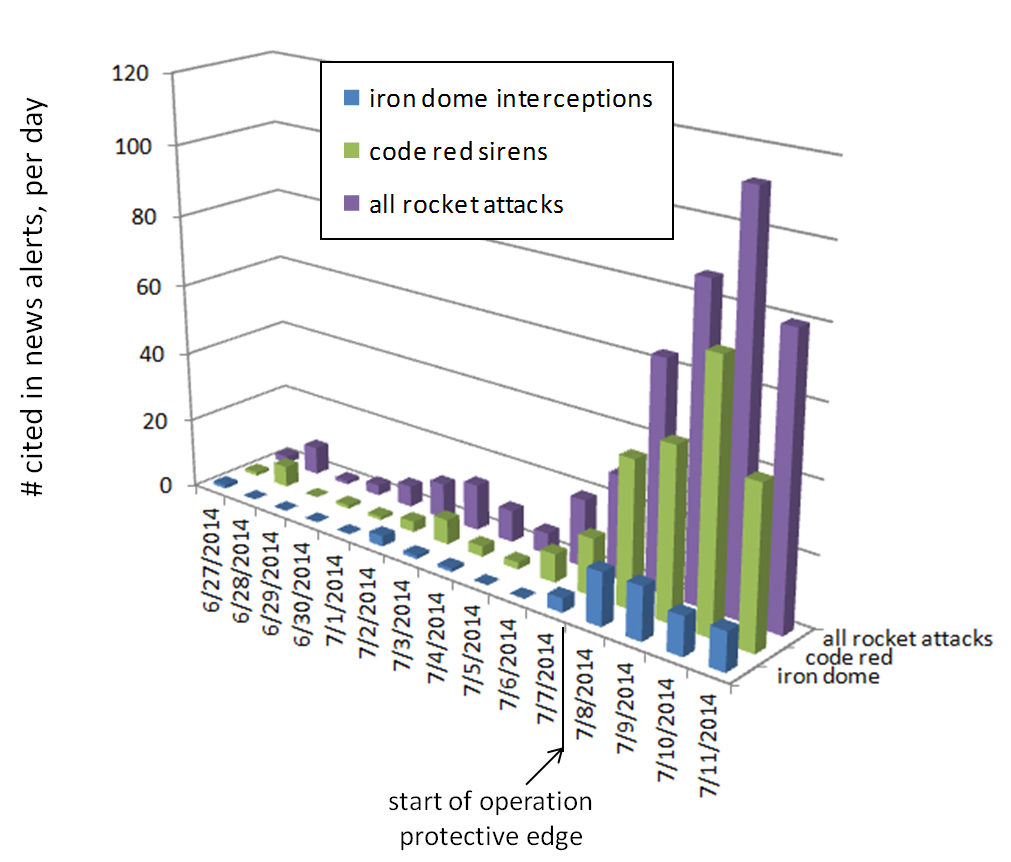
Here are the numbers of rocket barrages against Israel on a daily basis in the last couple weeks (it's the same underlying data as in the map -- gathered from reports in the ynet news ticker). Note, the numbers refer to individual reports, and most of the reports involve multiple rockets. The purple bars represent the number of times that a rocket attack was reported on an Israeli city or region. You can see here the Israeli defenses at work: code red sirens and/or iron dome missile interceptions are mentioned in most of these reports. There were already a number of attacks against Israel each day for a week before this war began. Would that be acceptable for you, or would you bomb your enemy back? Israel's leadership actually showed some restraint before jumping in. Also, note that the last few days have seen 80 to 100 rocket barrages per day. What would you do if you were Benjamin Netanyahu? Would you stage an extended air assault, trying to blow up missile-launching targets and Hamas militants, as he's done? Would you send in ground troops?
Related Posts:
Beyond Rockets (maps here, from the last war)
Wednesday, January 8, 2014
Fool's wisdom
It’s okay to fail they said. Failure is the key to success. ‘It’s the key to success!’ they screamed. Your ears are still ringing. That’s what they told you then, because they didn’t understand. You hadn’t moved anywhere in months. Do they know what it’s like? You didn’t even have an idea where to go. Not only did you fail, but the mistakes you kept repeating were moronic. They weren’t ‘smart’ mistakes. You didn’t learn from them the first time – or the second or the third, or the fourth, or the fifth. And this wasn’t a grand struggle in the face of ultimate mysteries, or something. The things that caught you up were trivial things, which nobody else even struggles with.
Now that you know how you could have gotten out of the rut the whole time, it’s even worse. You had all the skills to get there from day one if you’d only been thinking straight. In the end, you solved the problem over the duration of a coffee. Now you’re in flow again. It’s insane to you that you could have gotten so stuck for so long that way. Look at how efficient you are when you’re flowing. It washes that stuck feeling away like a bad aftertaste. In the end, that stuckness was only temporary, and it was just a step to get here, wasn’t it? Think of the perspective you've now gained, all that wisdom. Failure is the key to success, you realize. You tell all of them.
Why are they covering their ears?
Now that you know how you could have gotten out of the rut the whole time, it’s even worse. You had all the skills to get there from day one if you’d only been thinking straight. In the end, you solved the problem over the duration of a coffee. Now you’re in flow again. It’s insane to you that you could have gotten so stuck for so long that way. Look at how efficient you are when you’re flowing. It washes that stuck feeling away like a bad aftertaste. In the end, that stuckness was only temporary, and it was just a step to get here, wasn’t it? Think of the perspective you've now gained, all that wisdom. Failure is the key to success, you realize. You tell all of them.
Why are they covering their ears?
Sunday, July 7, 2013
Getting to somewhere
Past cafes and restaurants and sandwich shops, dodging couples and bikestands, skipping over the piles of sewage at the rear of the shuk, and onto the beachside tayellet, I ran. Green and red and orange fluorescent lights flickered across women with strollers, bike riders, and slick torsos. Before long, the rainbow-colored hotel loomed before me. It’s where I usually turn around. But today, for some reason, I kept running.
Israeli folk dancers and peddlers of cheap perfume slipped past me. Intermittent crowds became clusters of dining families and teenagers out shopping. I was entering the port. A street angel held a child, and delighted parents took pictures. Kids played on scooters. I skipped down to a low dock to avoid a mass of people congesting the slim walkway bordering the marina, and, jogging on past all the crowds, came to where the waves boom like cannons against the walls of the dock and then erupt into saltwater sprays, a place beyond the pedestrians. Just past that is the bridge that marks the end of the port. For the first time I hesitated, for I’d never run past here before. But, feeling spry enough, I took but an instant to decide, and went on.
Somehow I lost sight of the beach. I passed alongside a factory guarded by serious-faced men with machine guns, followed the road inland, and then continued along a highway while cars swam languidly by. My attempts to get back to the beach were continually stymied. Beyond a small airport, I found myself on a dark dirt road, unsure if it would lead anywhere, but hoping it would provide a shortcut between highways and building complexes to the beach. Kitchy Israeli pop music trickled in on the breeze. It became louder around this bend and softer as I went behind a high mound of dirt, but progressively closer until I realized that my meandering path was leading me towards it. Then I burst out of the darkness into a set of young and middle aged revelers dancing under too-bright lights, too bright for a party but fit for an exhibition, as if their festival had been planned on a stage for my benefit. To what I owed this, I don’t know. I was tired, my knees ached, and I didn’t belong there, so I ran past them, and as I climbed the dune of shoveled dirt beyond the party, I slowed to a walk. What was on my mind now? Not that which had set me to run. Peace had swept in, with only disconnected thought snippets interpolating between the sounds of the night. A bird chose that moment to fly over me and squawk shrilly.
I had arrived at a vista from which I could see the staged party behind me, a smokestack from the factory jutting up from the south, and what I thought was the rim of the sea straight ahead. Fields and low enclaves inhabited the darkness, followed by a wide trench cutting off two long archipelagos of office buildings and apartment complexes, and beyond that, an even, grassy hillock atop the dunes lining the ocean. I glanced once more at the party and, with dirt cascading into my running shoes, slid down the far side of the dune. The night filled with crickets. I wondered, then, if I could see the stars, and was surprised to find that the night was half shrouded in clouds, a rarity for summer in Israel. I kept on. The way was straightforward, and in not too long I was back on another beachside tayellet, passing quiet conversers on park benches, nodding to an old couple planted down by the entrance to the beachfront, and then, rounding a tall dune, making it back where I was aiming -- to the beach.
The beach was dark, quiet, and empty. Only occasionally did I pass solitary walkers, mostly lost in their own reveries, faces featureless in the shadows. Hot plumes of ocean air rolled over me and swept up the dunes, which were as tall as houses, and the stir of the waves over the low natural jetty obscured all other noises. I passed a couple having wine by the light of a headlamp and a fisherman whose head swiveled the whole way around to keep tabs on me, as if he were suspicious I might contaminate the night’s stillness. I looked backward and forward. Cities stood on both horizons, equidistant: the smokestack, high-rises, and lights of Tel Aviv to the south, and a mirrored collection of lights and buildings to the North, which I suppose were Natanya. Once more, I hesitated. My mind was now tuned into the night’s sensual offerings, with my initial thoughts dissolved into the ocean’s roll and the natural solitude of the duned, darkened landscape. I hadn’t thought about getting back, and now I started to wonder -- how would I? But the thought washed away, and my body said “forward,” and I obeyed.
Fireworks suddenly rose one after the other like phosphorescent palm trees across the northern skyline, their low thuds blowing in softly, long moments after the palm trees themselves had evaporated. I kept on, not able to move faster than a walk for the last hour probably, thirst beginning to harden my throat, yet determined. After a long while, high dunes and low jetties finally fell away, and I emerged at the other end of the beach into a Disneyland tayellet, with manicured grass on multiple clean terraces broken neatly apart by curvilinear rock walls. There was a water fountain. I drank and then sat, watching the waves break apart over the jetties.
I was here, I was -- where? Somewhere.
The city lights to the North were still a ways off, but not nearly as distant as the Tel Aviv lights, which shimmered like a tiny bundle of lightning bugs. I had gone far past the halfway point, far past the point from which my body could carry me comfortably back. I hadn’t budgeted for the return; I had only blazed forward, carried first by my legs and then by my spirit, and now I had gotten to this somewhere, and I felt lost. Thirst abated, I felt a deep strain in my leg ligaments, long unaccustomed as they were to running. I looked back and forth and then out to the ocean. The waves rolled in endlessly. For a while I stayed, soaked in sweat, sand carpeting my insoles, the tayellet's floodlights overpowering the dark night I had journeyed through to get there. Wherever I was going, no matter how weary I felt, I couldn’t stay here. I would have to keep moving. Somehow, I would have to get home.
Related posts:
Elderly, shmelderly
Tastes fresh, the way a cucumber raw in my salad
Monday, February 4, 2013
In Search of Proust's Way
“To admit you to the “little nucleus,” the “little group,” the “little clan” at the Verdurins’, one condition sufficed, but that one was indispensable: you must give tacit adherence to a Creed one of whose articles was that the young pianist whom Mme Verdurin had taken under her patronage that year and of whom she said “Really, it oughtn’t to be allowed, to play Wagner as well as that!” licked both Planté and Rubinstein hollow, and that Dr. Cottard was a more brilliant diagnostician than Potain.”
So begins part two of Swann’s way, the first one of the seven volumes of Marcel Proust’s masterpiece, In search of lost time. Swann’s way was handed to me by my friend Hagai as he was packing his things several months ago to leave Israel. “Take it,” he said. “It’s a marvelous novel. There are sections about nature, which are generally boring. But the sections about society, relationships, and memory are exquisite. I think you’ll find it worth your while.”
Well it certainly was a while: it took me over two months to read. But in sum, I also feel it was definitely worth it.
Proust is notorious for being difficult, for being pretentious, and also, with his great novel often touted as the definitive masterpiece of modernist literature, for being one of the greatest writers in history. In Search of Lost Time is the choice tome for many literati when asked the ‘what would you take to read if you were stuck on a desert island’ question. But let’s discard these prejudices, because indeed when I approached Proust I didn’t really know what I was getting into. All I had to go on was the recommendations of a close friend.
I finished Swann's way just this weekend, turning the last page with nostalgia almost as if I had relived a childhood. As is true of the events of actual life, the most prominent feature of the earlier parts of the novel was not a collection of sharp instances or details, but rather a haze which is best defined by the emotions it has the power to conjure. The book itself is, not surprisingly, Proustian (by this I refer to the principle of involuntary memory). I couldn’t even recall the individual events of the novel which had conspired to generate this nostalgia in me, for many of them had been submerged into the atmosphere of the thing and were certainly not in themselves relevant. Finishing it gave me the same longing and apprehension that one gets when approaching a life transition, or when saying adieu to a loved one.
But attaining this feeling came at a cost, for getting through the novel was, as it was promised to be… difficult.
There are three sections to Scott Moncrieff’s translation of Swann’s way: Combray, Swann in Love, and Place-Names: The Name.
Combray was the tough one. There were vignettes in it that kept me happily reading, but those were interspersed between long slogs. Comprising sometimes dozens of pages of florid description with no plot, the slogs were equally abstruse as they were slow. The whole book is, in fact, written in long, periodic, convoluted sentences that use a vocabulary of the very highest English, all of which requires rather a lot of attention to follow. (I’m strange in that I actually particularly liked this). Proust is not to be read by the impatient or the attention deficit. Despite all this, and because I glimpsed brilliance in certain segments of Combray, I never seriously considered putting the book down. But I wasn’t sure if I would ever really get into it, or rather if the book would remain as merely a time-consuming curiosity in my life-history of reading.
All of that changed with the sentence that I pasted at the top of this blog post. Within pages of starting part two (Swann in Love), I was mesmerized. A two month journey had gotten me through the 264 pages of Combray, but I swept through the 279 pages of Swann in Love in about 4 days. Consider that the sentence at the start of this blog is neither more nor less complex than the average sentence in the Swann’s Way, and you will understand that I must have been very engaged to have done this.
I thought then that Combray should simply be skipped, because it and Swann in Love don't really need each other. However, I’m not so sure now. The last, short section of the book, with the awful name Place-Names: The Name (which I’m guessing comes from a clunky translation of the French), evokes both Combray and Swann in Love and creates certain images which, without the context of Combray, would lack the lingering depth perhaps best characterized by feeling something just at the tip of your tongue, which you just can't quite put a name on. I was impressed by the crafting of this emotion, and I realized that without Combray, the effect would have been thinner.
Combray focused on the narrator’s childhood, and, like childhood itself, was richer in impressions than in happenings. The very fact that it was difficult, that it took a long time to get through, also played a role in its power. The focus, like childhood’s, wasn’t on plot, but rather on an experience that is often characterized by its very lack of occurrences. The book purposely slowed me down, and forced me into its own, drawn out pace. Only because of that was I able to relish the ending, for I felt as if I had been on some sort of a journey by the time that I got there, with its slow and its faster bits, which is ultimately more similar to life than is any pulp or, indeed, the majority of the media of modern consumption.
Proust is not an author who I feel will appeal all too easily to most modern readers, because, like the literature we have demanded and received, we order our emotions in digestible bites. Proust couldn’t have cared less about word counts or succinctness, which sets him at odds with nearly all modern authors. We live in a world now in which attention is one of the greatest currencies, and grabbing the attention of a consumer is so critical that most of the art about us is designed to first draw us in, and then, perhaps, to release its slower and subtler influences. Without the marketing feature at the outset, these works would simply be ignored. Who has the time to read something that doesn’t get right to the point?
But there is a value in not getting to the point, because life itself doesn’t get to the point, either. Proust certainly could have managed to tell the same story in less or in simpler words, but I don’t believe he even would have wanted to. If you are to appreciate this book’s merits, you are to surrender to Proust’s meanderings, and you are to trust him that these meanderings will be worthwhile. If you don’t trust him, don’t start. I believe that Proust wanted to capture the moments he described in his story as if they were emotional photographs, and to a large degree, difficult as it is, I believe he succeeded.
I have enough faith in Proust now that I'm ready to follow him through another 6 volumes. The end of Swann's way leaves me feeling satisfied but as if the ground has been set for something far bigger. Hopefully I can manage to get my hands on the rest of the set before I ever get stranded on some desert island…
Thursday, January 3, 2013
Knafeh Ninja Whomp
Roman [3:50p,12/27/2012]: Yo! What time ur going today?
Me [3:59p,12/27/2012]: Yoyo, maybe 7?
Roman [3:59p,12/27/2012]: Yap
My hand quivered over my mouse. Milky brown coffee residue lined my porcelain cup, and sugar crystals were splayed over the saucer. Too many coffees. I tried to concentrate on my work but my hand kept drifting back to my phone, and my eyes to the clock. Just a couple more tasks...
I raced out of work as soon as I could, ran after the bus and just barely caught it, and, after gathering my climbing gear, rolled my bike out of my flat within minutes. Halfway to the climbing gym, I felt my pants buzzing. Jeremy was calling me.
“Hey, I’m here already,” he said.
“I’ll be there in three minutes,” I replied, huffing.
“Okay--I’m waiting outside.”
I squeezed the phone back into my pocket and pedaled the rest of the way there. And--there was Jeremy, dressed in what could have been breakdancing attire, a baby-sized yellow pack on his back, and his goateed face breaking into a broad grin. We hugged. Electronic music pumped out of the climbing gym in an overwhelming volume.
“Whoa it’s loud!” I yelled.
“Yea, they’ve been playing around with the volume since I got here!” He yelled back.
“Come on!”
Escorting Jeremy into a climbing gym is like bringing a child into a cookie factory. But tonight the gym’s owner was throwing a party, so aside from the live DJ making the place whomp, there were also a gazillion people. We wove through the crowds. Jeremy’s pupils dilated at the first sight of climbing holds. The moment reminded me of a long time ago, back when Jeremy and I used to visit playgrounds and climbing walls and muck about trying to climb everything in sight. We were just kids then. We grew up together in Raleigh, North Carolina, and a big part of our childhood involved sleeping over at friends’ houses and making up breakdance moves or climbing on trees or over fences or trying amateur parkour. I stuck with climbing while Jeremy merely continued to dabble in everything, his natural talents sufficient to keep him happily lazy.
Pretty soon though we were hopping around the climbing gym just like kids again. Jeremy had his smartphone out and was taking photos and videos, in between traversing the wall on big jugs. I was doing some warmup dynos. “Do that move again,” he said to me at one point, breathing hard and holding the camera up. I tried jumping to a blunt grey sloper, slipped off, and rolled onto my back on the mat. Just as I stood up I felt a large hand grasp my shoulder, and when I turned around there was Roman, tall and hunched and wearing a crooked grin and a grey hooded jacket, his hair as disheveled as ever.
“Romansky!” I shouted. “C’mon, I’ve got to introduce you. This is my friend Jeremy I grew up with…”
Everyone showed up over the next hour. There was Dana, red hair knotted tightly to her head and eyebrow ring gleaming as she wrinkled her brows and narrowed her eyes and struck an aggressive pose, and then broke it up with a huge smile and bear hugged me. Iv, insouciant as ever, sauntered in slapping five and saying what’s up to half the people he passed. He saw me and Roman and dropped his head and chuckled. His dark bangs curled down over his eyes. Then he opened his long arms wide and hugged each of us. Marina moseyed in and, seeing us, gave a little body wiggle and laughed. When Moriel and Claire showed up, Claire butted me out of the way and hugged Jeremy. “You must be Jeremy. It’s so nice to finally meet you!” Moriel and I shrugged and went for the beer. Pretty soon Jeremy was cracking jokes with everyone and telling stories about our youth. I felt a little warmth inside. It was rare to be able to share a night like this with such an old friend, and to have it all in such a good spirit. He and my Tel Aviv crew were already getting along swimmingly.
We all climbed for a few hours but beer eventually took precedence, and the mood went from athletic to party. The energy in the place rose along with the music, and the lights dropped. Finally, the inside of the gym evolved into a club scene. By then I was out in the back with most of my friends, licking my fingers clean of hamburger juice and chomping potato chips.
“I don’t want to push anything, but there’s a whole bunch of ladies in there dancing, and that isn’t going to last forever…” Jeremy said. I nodded at him. The two of us hopped up and joined the mixed hiphop and trance groove, and within minutes, all of our friends had joined in as well. And then, as if some signal had spontaneously struck inside of everyone’s skull, it seemed that the whole party burst at once onto the dancefloor. I thought back over some of the more outrageous moments from our little community, and I guess I shouldn’t have been too surprised to see all of these folks busting a move--
--not, at least, considering our trips down to Timna, which included a whole carnival of colorfully garbed characters descending upon a red desert setting for Purim, spending our days exploring sandstone blocks and our evenings bouldering by headlamp in full costume, and eating the delicious all-Israeli dutch-oven stew called poike. Not to mention the Israeli bouldering competition, and my friends’ devious and wildly successful scheme to get everyone, guys and girls, dressed up in 80’s style spandex--
--I looked about me again, feeling the bass whump. There was Jeremy doing the robot, as pneumatic as a collection of steam pistons; and next to him Iv, doing his best to teach me the shuffle, his big arms and long body flailing about like comedy props; and there was Claire, thrusting and thumping, her look saying “This is my dancefloor,” just before she broke into a sheepish grin; not to mention Ayelet pulling out some of her old Electro-party dance moves; and finally Valerie and Rony and others, faces lit up with laughter, and their bodies a blur.
The dancing eventually died down and then ended, and we all hung out and chattered and played acro yoga games for a while. Finally, Jeremy was off, with a hug and a promise to meet up back in Raleigh. “We haven’t partied like that since… well, ever,” he said. The rest of us dispersed soon after in various directions.
But the weekend was only just started.
Roman [1:47p,12/28/2012]: Shall I get a crate of beer?
Me [1:49p,12/28/2012]: This is IV. Beer!!!
The next evening, I found myself swooshing off with the same crew towards the outdoor climbing area Ein Fara for the annual Israeli climbing festival, Festipus. We arrived just in time to grab dinner. There was a chill in the air that hovered just outside of our down jackets, but the mood was festive, with people all about the campground playing guitars, talking, laughing, and sharing stories and jokes.
Within a few minutes my friends had all frozen in place in a circle, exhaled breaths curling up into mist, the only motion an occasional arm swiping down towards a stray hand. We were playing ninja, a game in which we take turns trying to slap each other’s hands with minimal extraneous movement, with two slapped hands meaning you’re out.
We had played this game with increasing vigor on each climbing trip that we’d taken over the last year, and by now, it had taken on a nearly archetypal significance. Iv was here on the ground crawling between someone’s legs, there sliding back to back with an enemy, and finally was stretched wide in the center of the circle, arms tauntingly close to the other players, posture deliberate and exaggerated. Yonat, sweet looking but with a catlike ferocity, moved in brief spurts which always ended in loud cries from victims and winces from onlookers. Dana kept a low profile but now and again pulled a zinger out of her puffy jacket sleeve. And then there was little Rony, as silent and deadly as a possum. Our fun caught on and a couple of traveling Americans, as well as a bunch of Israelis, joined in with us. At one point we had fifteen people in the circle and a number of onlookers cheering. Ninja shifted to zoo, to charades and to cowboys and princesses, and other pantomime games. We were almost unable to breathe through our laughter.
The next day dawned cold, and after wiping sleep from our eyes, we all got down to the serious business of rockclimbing. Crisp winter air kept the wall just cool enough for good friction. Iv and I climbed a few steep and pumpy routes in between breaks to drink coffee and greet friends from different areas of Israel. The day swept in and then out and, before we knew it, we were stopping in a small Arab village for a hummus on the way back to Tel Aviv.
Because Roman was driving, we had to go into the sweets shop across the street after our hummus to eat Knafeh, an arab treat consisting of sweet goat cheese and a gooey orange rose-flavored syrup-soaked straw-noodle topping, sprinkled with pistachios. “It’s not Yefet street, but it’s really good--you must eat this one,” he said. We tried three varieties, each one of them sweeter and more delectable than the last, and followed them with Turkish coffees. Five minutes later I was dead asleep in the back of the car.
I woke up when we dropped off our first passenger, Ayelet. I waved weakly at her. Next was Iv. I was awake enough then to get out of the car, and we slapped five and both said simultaneously “New years” and grinned. Next was Marina, who was leaving the next morning on a month-long trip in Mexico. Roman and I hugged her goodbye and wished her safe travels. And finally it was just me and Roman in the car, both wearing lazy smiles. We drove in silence for a few minutes.
It was only seven o'clock, but my body was wracked from a weekend of nonstop action and rockclimbing, and from barely sleeping. But I couldn’t have thought of a better way in which to have spent it. There was something special here, now, with this group of people. Kind of a resonance.
Roman nodded, feeling the same mood. And then he said: “Don’t worry man, this isn’t it. There will be more of these.”
I took a deep breath and felt the hum of the engine. I knew it was true, and I knew that it wasn’t. But there’s nothing to do but to grasp on to these moments as they’re happening. After all, they each but occur once.
We slapped five and I got out of the car. I grabbed my pack, shut the door and waved. I watched Roman pull out of the spot and drive off. And I went up to my flat, exhausted and happy. Just in need of a little sleep before the next big adventure.
Me [3:59p,12/27/2012]: Yoyo, maybe 7?
Roman [3:59p,12/27/2012]: Yap
My hand quivered over my mouse. Milky brown coffee residue lined my porcelain cup, and sugar crystals were splayed over the saucer. Too many coffees. I tried to concentrate on my work but my hand kept drifting back to my phone, and my eyes to the clock. Just a couple more tasks...
I raced out of work as soon as I could, ran after the bus and just barely caught it, and, after gathering my climbing gear, rolled my bike out of my flat within minutes. Halfway to the climbing gym, I felt my pants buzzing. Jeremy was calling me.
“Hey, I’m here already,” he said.
“I’ll be there in three minutes,” I replied, huffing.
“Okay--I’m waiting outside.”
I squeezed the phone back into my pocket and pedaled the rest of the way there. And--there was Jeremy, dressed in what could have been breakdancing attire, a baby-sized yellow pack on his back, and his goateed face breaking into a broad grin. We hugged. Electronic music pumped out of the climbing gym in an overwhelming volume.
“Whoa it’s loud!” I yelled.
“Yea, they’ve been playing around with the volume since I got here!” He yelled back.
“Come on!”
Escorting Jeremy into a climbing gym is like bringing a child into a cookie factory. But tonight the gym’s owner was throwing a party, so aside from the live DJ making the place whomp, there were also a gazillion people. We wove through the crowds. Jeremy’s pupils dilated at the first sight of climbing holds. The moment reminded me of a long time ago, back when Jeremy and I used to visit playgrounds and climbing walls and muck about trying to climb everything in sight. We were just kids then. We grew up together in Raleigh, North Carolina, and a big part of our childhood involved sleeping over at friends’ houses and making up breakdance moves or climbing on trees or over fences or trying amateur parkour. I stuck with climbing while Jeremy merely continued to dabble in everything, his natural talents sufficient to keep him happily lazy.
Pretty soon though we were hopping around the climbing gym just like kids again. Jeremy had his smartphone out and was taking photos and videos, in between traversing the wall on big jugs. I was doing some warmup dynos. “Do that move again,” he said to me at one point, breathing hard and holding the camera up. I tried jumping to a blunt grey sloper, slipped off, and rolled onto my back on the mat. Just as I stood up I felt a large hand grasp my shoulder, and when I turned around there was Roman, tall and hunched and wearing a crooked grin and a grey hooded jacket, his hair as disheveled as ever.
“Romansky!” I shouted. “C’mon, I’ve got to introduce you. This is my friend Jeremy I grew up with…”
Everyone showed up over the next hour. There was Dana, red hair knotted tightly to her head and eyebrow ring gleaming as she wrinkled her brows and narrowed her eyes and struck an aggressive pose, and then broke it up with a huge smile and bear hugged me. Iv, insouciant as ever, sauntered in slapping five and saying what’s up to half the people he passed. He saw me and Roman and dropped his head and chuckled. His dark bangs curled down over his eyes. Then he opened his long arms wide and hugged each of us. Marina moseyed in and, seeing us, gave a little body wiggle and laughed. When Moriel and Claire showed up, Claire butted me out of the way and hugged Jeremy. “You must be Jeremy. It’s so nice to finally meet you!” Moriel and I shrugged and went for the beer. Pretty soon Jeremy was cracking jokes with everyone and telling stories about our youth. I felt a little warmth inside. It was rare to be able to share a night like this with such an old friend, and to have it all in such a good spirit. He and my Tel Aviv crew were already getting along swimmingly.
We all climbed for a few hours but beer eventually took precedence, and the mood went from athletic to party. The energy in the place rose along with the music, and the lights dropped. Finally, the inside of the gym evolved into a club scene. By then I was out in the back with most of my friends, licking my fingers clean of hamburger juice and chomping potato chips.
“I don’t want to push anything, but there’s a whole bunch of ladies in there dancing, and that isn’t going to last forever…” Jeremy said. I nodded at him. The two of us hopped up and joined the mixed hiphop and trance groove, and within minutes, all of our friends had joined in as well. And then, as if some signal had spontaneously struck inside of everyone’s skull, it seemed that the whole party burst at once onto the dancefloor. I thought back over some of the more outrageous moments from our little community, and I guess I shouldn’t have been too surprised to see all of these folks busting a move--
--not, at least, considering our trips down to Timna, which included a whole carnival of colorfully garbed characters descending upon a red desert setting for Purim, spending our days exploring sandstone blocks and our evenings bouldering by headlamp in full costume, and eating the delicious all-Israeli dutch-oven stew called poike. Not to mention the Israeli bouldering competition, and my friends’ devious and wildly successful scheme to get everyone, guys and girls, dressed up in 80’s style spandex--
--I looked about me again, feeling the bass whump. There was Jeremy doing the robot, as pneumatic as a collection of steam pistons; and next to him Iv, doing his best to teach me the shuffle, his big arms and long body flailing about like comedy props; and there was Claire, thrusting and thumping, her look saying “This is my dancefloor,” just before she broke into a sheepish grin; not to mention Ayelet pulling out some of her old Electro-party dance moves; and finally Valerie and Rony and others, faces lit up with laughter, and their bodies a blur.
The dancing eventually died down and then ended, and we all hung out and chattered and played acro yoga games for a while. Finally, Jeremy was off, with a hug and a promise to meet up back in Raleigh. “We haven’t partied like that since… well, ever,” he said. The rest of us dispersed soon after in various directions.
But the weekend was only just started.
Roman [1:47p,12/28/2012]: Shall I get a crate of beer?
Me [1:49p,12/28/2012]: This is IV. Beer!!!
The next evening, I found myself swooshing off with the same crew towards the outdoor climbing area Ein Fara for the annual Israeli climbing festival, Festipus. We arrived just in time to grab dinner. There was a chill in the air that hovered just outside of our down jackets, but the mood was festive, with people all about the campground playing guitars, talking, laughing, and sharing stories and jokes.
Within a few minutes my friends had all frozen in place in a circle, exhaled breaths curling up into mist, the only motion an occasional arm swiping down towards a stray hand. We were playing ninja, a game in which we take turns trying to slap each other’s hands with minimal extraneous movement, with two slapped hands meaning you’re out.
We had played this game with increasing vigor on each climbing trip that we’d taken over the last year, and by now, it had taken on a nearly archetypal significance. Iv was here on the ground crawling between someone’s legs, there sliding back to back with an enemy, and finally was stretched wide in the center of the circle, arms tauntingly close to the other players, posture deliberate and exaggerated. Yonat, sweet looking but with a catlike ferocity, moved in brief spurts which always ended in loud cries from victims and winces from onlookers. Dana kept a low profile but now and again pulled a zinger out of her puffy jacket sleeve. And then there was little Rony, as silent and deadly as a possum. Our fun caught on and a couple of traveling Americans, as well as a bunch of Israelis, joined in with us. At one point we had fifteen people in the circle and a number of onlookers cheering. Ninja shifted to zoo, to charades and to cowboys and princesses, and other pantomime games. We were almost unable to breathe through our laughter.
The next day dawned cold, and after wiping sleep from our eyes, we all got down to the serious business of rockclimbing. Crisp winter air kept the wall just cool enough for good friction. Iv and I climbed a few steep and pumpy routes in between breaks to drink coffee and greet friends from different areas of Israel. The day swept in and then out and, before we knew it, we were stopping in a small Arab village for a hummus on the way back to Tel Aviv.
Because Roman was driving, we had to go into the sweets shop across the street after our hummus to eat Knafeh, an arab treat consisting of sweet goat cheese and a gooey orange rose-flavored syrup-soaked straw-noodle topping, sprinkled with pistachios. “It’s not Yefet street, but it’s really good--you must eat this one,” he said. We tried three varieties, each one of them sweeter and more delectable than the last, and followed them with Turkish coffees. Five minutes later I was dead asleep in the back of the car.
I woke up when we dropped off our first passenger, Ayelet. I waved weakly at her. Next was Iv. I was awake enough then to get out of the car, and we slapped five and both said simultaneously “New years” and grinned. Next was Marina, who was leaving the next morning on a month-long trip in Mexico. Roman and I hugged her goodbye and wished her safe travels. And finally it was just me and Roman in the car, both wearing lazy smiles. We drove in silence for a few minutes.
It was only seven o'clock, but my body was wracked from a weekend of nonstop action and rockclimbing, and from barely sleeping. But I couldn’t have thought of a better way in which to have spent it. There was something special here, now, with this group of people. Kind of a resonance.
Roman nodded, feeling the same mood. And then he said: “Don’t worry man, this isn’t it. There will be more of these.”
I took a deep breath and felt the hum of the engine. I knew it was true, and I knew that it wasn’t. But there’s nothing to do but to grasp on to these moments as they’re happening. After all, they each but occur once.
We slapped five and I got out of the car. I grabbed my pack, shut the door and waved. I watched Roman pull out of the spot and drive off. And I went up to my flat, exhausted and happy. Just in need of a little sleep before the next big adventure.
Saturday, December 8, 2012
Elderly shmelderly
What should I do with my elderly vegetables?
I had a pile of them in front of me this morning, from the rather fresh to the marginally edible. I sorted them into groups. One group was for the dumpster. This included a few moldy tomatoes and eggplants. Then there was another group which looked healthy and fine. Those were the obvious keepers. But between them was the third group--the wrinkled old ones. These ones had velvety skins. They looked like they had been through rough days, and had stories to tell. In fact, I know that some of them did.
That red bell pepper had gotten sliced back in his prime, when he was a young chap full of ego and crunch. I had enjoyed his fragrance and his crispness then. Next to him was the twisted orange pepper, a bad little man who carried just the whiff of heat to keep it interesting, but who most of all was surprisingly tangy and sweet. He had completed one of my salads. And the onion, oh so neglected. “You eat my friends all the time,” he seemed to whine, “but little old me, you just stuck me in the back of the fridge and forgot about me, didn’t ya.” He had shriveled away from his old purple luster, down and down into a tight and curled knot. I could see the disregard on him, layers which had softened or peeled away and were useless. He didn’t look appetizing.
I stalled. I picked the veggies up and got ready to trash them, but, not being able to bring myself to it, I put them back down again. The silly thing was, I had all of the same vegetables in my “fresh” group. I didn’t need these. On the counter nearby there were two red bell peppers, the color of wine and nearly exploding out of their smooth folds with young pride. Right next to them sat a spotless orange pepper, the same variety as that old grizzled hothead who had livened up my salad. And on my spice shelf were a few onions, lording about like they owned the place.
But now I had these chaps who were wrinkled but edible, which had shriveled up but not rotted, and who seem to stare at me with their vegetable eyes and say “what about us?” I watched them and they watched me. They never blinked. Finally, giving in, I started slicing them. Today I would make my eggs using only the elderly ones, and we’d have to just see.
So I’m taking my breakfast now on the balcony of my building, up the stairwell, with my feet propped up on the railing and a cup of coffee. The vegetables are good. They seem to have mellowed out but gained a wider spectrum flavors with their age, making it worth chewing more at each bite. I’m glad that I chose them. It’s a chilly day and it’s Shabbat so the neighborhood’s pulse is pretty tame now, with just some tourists and a few locals walking dogs or strolling, and some crazy fat lady going up and down the street singing nonsense. I am struck by the fact that just over two weeks ago, I was in the same stairwell as this balcony, hiding from rockets, and now I’m mostly concerned about the fate of my elderly vegetables.
I think back and yes, maybe one of these veggies was even around then. Well, I’m not sure. The conflict with Hamas feels like it never happened, almost, just as these veggies, so precious when I first sliced them, sat forgotten in a cold place while my life swished away elsewhere. It’s strange just how quickly and fully we can forget things. I just celebrated a birthday, so I guess I’m thinking a bit more about it right now. I hope that I’ll age well, like these veggies. Well, look at me… now I’m getting all sentimental. Seeing anything that has been left forgotten strikes a chord with me. To curl up alone in the refrigerator is a sad fate for a bell pepper.
Breakfast is done. I’ve finished all of my old guys, and it’s only the young guns left over in my apartment now. Will I eat them fresh? Will they end up neglected, too? Who’s to say? One day at a time, little fellas. I’m off to life, to hopefully scooping up a few more flavors myself on the big journey. I have a lot more to do out there. Gotta get it all while it's hot, while there's still sizzle in the pan. After all, one day I, too, will be an elderly vegetable.
I had a pile of them in front of me this morning, from the rather fresh to the marginally edible. I sorted them into groups. One group was for the dumpster. This included a few moldy tomatoes and eggplants. Then there was another group which looked healthy and fine. Those were the obvious keepers. But between them was the third group--the wrinkled old ones. These ones had velvety skins. They looked like they had been through rough days, and had stories to tell. In fact, I know that some of them did.
That red bell pepper had gotten sliced back in his prime, when he was a young chap full of ego and crunch. I had enjoyed his fragrance and his crispness then. Next to him was the twisted orange pepper, a bad little man who carried just the whiff of heat to keep it interesting, but who most of all was surprisingly tangy and sweet. He had completed one of my salads. And the onion, oh so neglected. “You eat my friends all the time,” he seemed to whine, “but little old me, you just stuck me in the back of the fridge and forgot about me, didn’t ya.” He had shriveled away from his old purple luster, down and down into a tight and curled knot. I could see the disregard on him, layers which had softened or peeled away and were useless. He didn’t look appetizing.
I stalled. I picked the veggies up and got ready to trash them, but, not being able to bring myself to it, I put them back down again. The silly thing was, I had all of the same vegetables in my “fresh” group. I didn’t need these. On the counter nearby there were two red bell peppers, the color of wine and nearly exploding out of their smooth folds with young pride. Right next to them sat a spotless orange pepper, the same variety as that old grizzled hothead who had livened up my salad. And on my spice shelf were a few onions, lording about like they owned the place.
But now I had these chaps who were wrinkled but edible, which had shriveled up but not rotted, and who seem to stare at me with their vegetable eyes and say “what about us?” I watched them and they watched me. They never blinked. Finally, giving in, I started slicing them. Today I would make my eggs using only the elderly ones, and we’d have to just see.
So I’m taking my breakfast now on the balcony of my building, up the stairwell, with my feet propped up on the railing and a cup of coffee. The vegetables are good. They seem to have mellowed out but gained a wider spectrum flavors with their age, making it worth chewing more at each bite. I’m glad that I chose them. It’s a chilly day and it’s Shabbat so the neighborhood’s pulse is pretty tame now, with just some tourists and a few locals walking dogs or strolling, and some crazy fat lady going up and down the street singing nonsense. I am struck by the fact that just over two weeks ago, I was in the same stairwell as this balcony, hiding from rockets, and now I’m mostly concerned about the fate of my elderly vegetables.
I think back and yes, maybe one of these veggies was even around then. Well, I’m not sure. The conflict with Hamas feels like it never happened, almost, just as these veggies, so precious when I first sliced them, sat forgotten in a cold place while my life swished away elsewhere. It’s strange just how quickly and fully we can forget things. I just celebrated a birthday, so I guess I’m thinking a bit more about it right now. I hope that I’ll age well, like these veggies. Well, look at me… now I’m getting all sentimental. Seeing anything that has been left forgotten strikes a chord with me. To curl up alone in the refrigerator is a sad fate for a bell pepper.
Breakfast is done. I’ve finished all of my old guys, and it’s only the young guns left over in my apartment now. Will I eat them fresh? Will they end up neglected, too? Who’s to say? One day at a time, little fellas. I’m off to life, to hopefully scooping up a few more flavors myself on the big journey. I have a lot more to do out there. Gotta get it all while it's hot, while there's still sizzle in the pan. After all, one day I, too, will be an elderly vegetable.
Saturday, June 23, 2012
Tastes fresh, the way a cucumber raw in my salad
I rinse my knife and put it aside, and then sponge down the two or three dishes left in the sink. It is satisfying to rinse the soap off, to watch the water drain away until the surface tension buckles, and to see my reflection fragment into globules. I don’t need to dry my dishes in this heat, so I let a bit more water dribble off and then I put each plate up in the cabinet. Empty sink.
I pull out my veggies, fresh from the market, and begin rinsing them too… and I’m thinking back over the week—like just yesterday, when I was analyzing what seemed like two hundred datasets. Projects with many scattered parts; to-do lists scribbled here and there and then abandoned in progress, some tasks completed, others bowled over. Too many goals, too many worries. I didn’t write the blog I intended to last week, finish that paper, read that book, cash those checks, pay those bills, respond to that friend’s email, and the worst, I haven’t renewed my visa yet, because I need the papers which require the letter which requires…
I’ve put my tomatoes to the right of the sink in my small kitchen, filling a glass bowl with the red orbs. Cucumbers pile on top. I wash them all with soap, because in the shuk they wash them with sewage water... a few more veggies to wash and I’m done, and now I’ve taken out my cutting board and I’m dicing. Tomatoes, cucumbers, fresh mint and parsley, red onion: I mix it all in a bowl and I squeeze on some lemon and add olive oil, salt and pepper.
How can it all seem so complicated when really, it’s so simple? I pull out a tub of fresh humus and spread it thick around a bowl, drop on a spoonful of tehini I mixed up with lemon and garlic, and then shake on fresh cumin and paprika. Raw, sliced onion and a few olives go in a dish to the side. A glass of water, a sprig of mint. I lay out lunch on my coffee table.
The salad goes well with the mint-water. My neighbor is practicing her violin again, stopping and redoing parts here and there... which for some reason relaxes me… and I eat a forkful of humus and an olive… and it strikes me that these unscripted days are the most natural ones, that schedules and stressors aren’t real, and that life isn’t about polish…
I’m scooping up the last of my humus with some challah. Later on, the time of schedules will start again. But even then, it’ll be good to remember I can see through them. And now I’m back at the sink with my bowl, watching the water bubble and then become smooth and then dribble off again, before I place the bowl in my high cabinet. I have goals, dreams, and desires, and they all require discipline and schedules. But not for right now. Today isn't about schedules. All I have left to do today is to meet some friends at the beach.
Sunday, January 8, 2012
Santa is a hummus thief!!
I stumbled out of bed late one Friday and sat down in the reggae bistro Abu Dhubbie for a hummus, thinking that I could share my lunch with a good book. I was just settling down when a drunk, homeless-looking woman wearing a Santa hat waddled over to the outermost table in the restaurant and blinked her glazed eyes a few times at the spread of food before her. Before anyone knew it, she had scooped her hand into the bowl of the closest diner, taken up a helping of hummus, and smeared it all over her lower face in the process of shoving it into her mouth. The diner immediately stood up, appalled and confused. Santa nonchalantly sat down in his chair and continued slurping the hummus straight out of his bowl.
Nobody seemed to know what to do. The woman’s actions were so beyond anybody’s experiences that even the waitstaff merely continued about their business, perhaps hoping that she would eventually disappear. But she did not disappear. As the rest of the diners at the table stood up and backed away from the table in something between disgust and outrage, the woman simply appropriated their bowls too, dipping her hands at leisure into four people’s meals and leaving everyone around her perplexed. After what seemed like quite a while of this, one of the waiters finally approached her and tried to persuade her to leave. They argued for a bit until the woman swiped a glass off the table to shatter on the ground, and then very profusely apologized and tried to help clean it, creating more of a scene in the process. Finally, with beige slop still dripping from her face and her hands, a table’s worth of diners standing and glaring at her, and the whole restaurant hypnotized by her strange antics, she poured leftover goop into a grocery bag and then ambled away. A waiter came around afterwards with a bottle of Arak and poured everyone free shots. It was a little something to help us forget the reality that had just been unremittingly shoved in our faces.
I strolled afterwards to a coffeeshop to do some computer work, but I had trouble concentrating. The woman’s behavior had captured my mind for the day. It was a strange mixture of hilarious and weird and just sad. Perhaps all of our desires begin like this woman’s, unbounded and uncouth and uninhibited. Most of us have merely been taught to keep enough within certain boundaries that when we take what we want, we do it in a way that seems ‘cultured’. Free as this woman was from usual mores, she simply acted her fantasies. She just sat right down and dipped her face and hands into people’s bowls because the food looked appealing to her. Certainly, to get to this place in her life, she must have experienced several varieties of hell. But in some sense her actions were more honest than those of the rest of us, who are able to obtain enough of our needs through acceptable channels that we can pretend that we’re ‘different’ and ‘civilized’, but who probably would act in the exact same manner if our usual support systems were cut out from us. Or would we? Is there a way to know how we would act under such circumstances? Are we driven fundamentally by base desires, or by some higher aspirations?
I read a fascinating perspective on this in Viktor Frankl’s ‘Man’s Search for Meaning.’ Frankl was a psychiatrist and philosopher who spent several years in Nazi concentration camps during the Holocaust. During this experience, he developed a new school of existentialist psychotherapy called Logotherapy, the basic tenet of which is that the basic human psychological need is a sense of meaning. In his book, he describes how within minutes of entering his first concentration camp, every external trapping that had been part of his self definition—his clothes, his valuables, his hair, the typed manuscript of his unpublished life work in psychoanalysis—were unceremoniously stripped from him. From then on, he lived in a terrestrial version of hell.
During this years-long ordeal, he came to realize that even these circumstances couldn’t suck the humanity out of some people. Amidst the squalor, sickness, filth, cold, constant discomfort and backbreaking labor, certain prisoners became even crueler than some of the camp guards, while others displayed almost unbelievable strength of spirit, even giving up morsels of their own food to others who were sick or dying despite the perpetual state of starvation under which they all suffered. One woman proclaimed to Frankl, as she was dying, with tears in her eyes, that despite the fact that she had lived a very wealthy and comfortable life beforehand, she was unboundedly grateful for the chance to live, and die, in the concentration camp. She explained that without being forced to experience this, she would never have achieved the spiritual heights that she did there. She would have lived and died a trite existence, never appreciating anything real, and would have felt empty both during and at the end of it all. What a striking proclamation!!
In Frankl’s philosophy, this woman had led a fulfilled life, because she had achieved a full sense of meaning. This is, he concluded, people’s underlying psychological purpose. If you can choose your own destiny, seek meaning by creating or appreciating art. If your destiny is forced upon you, seek meaning by embracing, and transcending, your suffering. Either way, meaning is the basic necessity that makes people tick. Perhaps it is a profound lack of meaning, a loss of faith that there even can be any meaning, which leads to behavior like that of the woman in the Santa hat. When satiation of basic needs is all that is left, and society is capable of offering nothing of value to you, why not just take what you want, breaking all of the rules that the majority of us honor? But then, even in a concentration camp, we can see that some people do find dignity and meaning although their circumstances clearly are not serving them. Some people give up their bread although they are starving. What could drive a person to do such a thing??
I’ve found it interesting having conversations about these types of issues with friends of mine who are scientists. It seems that many scientists feel that there is no such thing as meaning; there are merely impulses in the brain that give pleasure, and those that give displeasure, and a fulfilling life is one in which the pleasurable impulses are optimized. I find it interesting that people can be so adamant about a particular, materialistic interpretation of reality. They don’t allow for any fundamental meaning to the word ‘meaning,’ and use ‘logic’ and ‘science’ as justifications for this. They are as sure in their worldview as fundamentalists of any given religion are in theirs. ‘Feeling good’ and ‘feeling meaning’ are categorized blandly beneath ‘utilitarian desires,’ and optimization of personal utility becomes the reigning paradigm of human behavior.
Sometimes I discuss these same issues with friends who are religious, and I encounter such a different perspective that it is surprising that they and the scientists all carry the same neurological equipment. The idea of meaning, or faith, tends to be so assumed by these folks that it is indeed axiomatic to their approach to the world. You can’t disprove an axiom by logic, because an axiom is one of the statements with which logical proof begins. Science to these folks is a belief system that is useful, but fundamentally subservient to the deeper order imposed by their religious understanding. Scientific or logical inconsistencies in these beliefs just mean that the science is incomplete or is describing merely a subset of the full, richer reality. My religious friends might suggest now a moment of prayer for those unfortunate scientists, who have been so willfully driving their heads into the sand.
What I believe scientists sometimes forget is that science can disprove (although it is limited even in this!), but it can never actually prove anything. Science relies on observation, which is often incomplete, and logic, which as a system is fundamentally flawed, and cannot be applied completely and consistently to something even as simple as natural numbers, much less our universe (look up Godel’s incompleteness theorem if you disbelieve me). Science builds within paradigms, which are eventually shown to be incomplete and in fact wrong, leaving some items that were once ‘certain’ again completely open to new interpretation. In all of this, scientists often proclaim (most unscientifically, since they have no proof of this) that the objective reality we can probe with our instruments is the unique reality; this despite the fact that nobody in the history of the world has ever experienced anything but the subjective. They feel that the relationship between the objective and the subjective is unimportant, because if we have a functional view of how the objective alters the subjective, then questions of ‘what is the subjective’ become meaningless.
In this I think the religious folks have appreciated something correct in the human experience—that the subjective matters. However, too often, the logical extrapolation of these beginnings leads to belief in very specific and un-provable ‘truths,’ many of which come from books that are to be taken without question. These books, which could be interpreted mystically (and thus in a way not incompatible with other such ‘books,’ or other philosophies in general), are often instead interpreted literally. Literal interpretation of scientifically implausible events pits science against religion, and causes both to suffer. What is science without meaning? What is religion, debated and spread via technology that could only have come from the rigorous approaches of science, that denies science? And how on Earth is it possible that people actually view the world through such diametrically opposing perspectives?
Human experience is confusing enough that perhaps the only axiom we should employ is that we should be willing to question all of our axioms. If we are willing to look at what we believe, and then to systematically question each of these beliefs in context of all of the experience we have amassed in our lives, then we have a chance of seeing more clearly.
Most scientist types would say that this is exactly what they’ve done—that they’ve sloughed off all the inconsistent religious stuff in favor of the more logical approach—but I don’t quite believe them. I feel that it’s an easy way out, just as is believing without question in the words of a book. The entire artistic and spiritual side of existence is entirely ignored by these scientists, or subsumed (I believe inappropriately) into the ranks of utilitarianism. To say that there simply is no meaning, to deny or to minimize the very feelings that have led people to form the extravagant religious structures that exist, is to ignore a huge part of what it is to be human.
The truth must be somewhere in the middle, a philosophy that acknowledges the full range of human experience, morality, emotion, and art, in addition to being completely consistent with our universe. Like the logic of natural numbers, every completely consistent scientific interpretation of reality that I’ve heard always leaves out certain un-approachable problems. Why are we here? What does it mean to be conscious? How can we square our subjective experience with the world about us? What is meaning? How do we judge morality? The trouble is, these un-approachable problems are some of the very most important and interesting problems to humans. To pretend that these problems simply don’t exist, because they are not relevant or describable by science, misses the point. We don’t fundamentally need answers to scientific questions; we need answers to human questions. If science says that those questions don’t exist or are stupid because they don’t fit into the framework of science, than that simply means that science has failed us.
So Dear Santa,
Thank you for stealing those peoples’ hummus. Thank you for guiding my mind down this strange rabbithole. Perhaps we will meet again one day; perhaps we will not. But either way, I will be hoping that you can find your own type of happiness or meaning. If not, may you at least find some more hummus.
-Matthew
Saturday, November 12, 2011
Tangoing life
The other evening I was dancing tango with a woman who teaches swing, but for whom, like for me, tango is relatively new. I could tell she was enjoying our dance; a smile lit up intermittently on her face, and now and again she joined me in a little conspiratorial laughter. We seemed to have a nice rhythm. She was funny and snarky, too, which I liked. But while we were in between songs at one point, she said to me something that struck me: ‘for this next one, don’t THINK; just dance to the music.’ I joked that I would pay close attention to not thinking, but in the end her advice led to something fresh; the dance was much sloppier, but it felt more alive, as if we were using tango to channel the music, rather than using the music merely to keep pace in our tango. As the song came to a close we were both grinning like school-kids.
My dance partner’s challenge to ‘just dance’ was actually a relief to me. With her intuition as a dance teacher, she was telling me that I’m ready to shuck off some of my ugly duckling phase and to move forward—that I know enough now that I can play a bit, and that what’s most missing from my dance isn’t technical but rather lyrical. It’s one thing to do a cross or an ocho with exact timing. It’s another to use the ocho or the cross in creating a dramatic narrative, one that ebbs and bursts with the music. The narrative might even be juicier if the ocho is fumbled, or the cross isn’t perfect; it’s not the exactness of the individual steps but the improvisation towards the narrative that makes the dance float off the dancefloor.
I was also reminded that we needn’t master every conceivable tool to create something beautiful; rather, we must merely know how to use some tools well enough, and then it’s our soul that determines the outcome. In my tango, I can strive to create art from the few steps that I know, just as a good female dancer will strive to take the steps she is guided through and use their bounds as her own palette for expression. Equally, a dancer who knows many moves isn’t necessarily a good dancer, because it’s the interpretation and expression that make it a dance, not the mastery of technicalities.
In this sense, I feel that tango is very much like life. The man and the woman in tango each embody different struggles, which can be relevant at different times in anyone’s personal narrative. The man’s challenge is to create art from a limited repertoire. He succeeds if he manages to not think but to dance, to feel the tension of the music and the woman, and to bring something unique to them. He is like the majority of us, handed some instruments from our upbringing and education and then released to the world with the challenge to make the most of ourselves. The woman’s challenge in tango, on the other hand, is to take extremely confined circumstances and, through her spirit and soul, to transcend them. She is like those of us put under extraordinary physical or mental constraints, and left to find nobility and expression in the very embodiment of this struggle.
Paradoxically, when I watch extremely skilled dancers, it’s the woman, not the man, who appears to be running the dancefloor. Similarly, it’s the people in life who achieve spiritual heights under the greatest duress who generally garner the most human respect. It was through his spiritual response to decades of imprisonment, for example, that Nelson Mandela was able to bring a new political reality to South Africa. But tango is a dance, and like life it is fluid. The man is no prison and the woman no prisoner; he who can’t respond to the woman’s intention isn’t really dancing at all, despite the fact that, indeed, he is leading. How many couples in real life are like this? The best couples collaborate spontaneously, and neither can predict the outcome, for each is inextricably involved. The drama is rich.
On my way home after being told to just dance, I passed a few cafes filled with people conversing and laughing, and it struck me that these people too had spent the night tangoing. How many of them were just dancing themselves, never even realizing their perfectly timed steps? They weren’t thinking about the mechanics of their conversations nor about the relationships they were nurturing; they were just living and enjoying their night out, and in the process creating some sort of life tango. Likewise, friends can gather again and again over a chessboard, trying their mightiest to become masters, only to realize in old age that it was the narrative of their gatherings through which they attained mastery at something much richer. It’s usually only afterwards, sometimes years afterwards, perhaps even only at the very end, that we can see which of the tangos in our lives were the most meaningful.
Life’s dance is elusive; we might feel it at moments for what it is but not realize that the dancefloor has already shifted, and then we might be left fumbling again, trying to work through a new set of uglies although we had previously thought we had mastered it all. Things can change suddenly, such as in the death of a loved one. If this process were more linear then it wouldn’t be life, for in life, there’s no guide but experience, and experience itself is what creates the rules of one’s tango. Perhaps as we grow old we’ll have discovered our true narratives, and we’ll be able to look back fondly and laugh at it all. If we are rich in our spirits then we’ll certainly do so. The trick, then, is to try and catch ourselves dancing, and then to determine what exactly it is that we’re dancing to. In some cases we might even be able to mold our own dancefloor as we skip breathily over it. But even when we can’t choose our own tangos, we can still dance with abandon. And I think it’s through this unintentional dancing that we’ll discover life’s ultimate meaning.
Sunday, February 20, 2011
Sitting in peering out
I've been a month and a half now in Tel Aviv and it's been a whirlwind. I'm not exactly certain where to start; perhaps it makes sense then to start at the beginning.
I stayed the first few days I was here with my good friends Moriel and Claire, and then subletted a room from a great couple named Jackie and Michal while I searched for an apartment. Finding a good apartment in Tel Aviv isn't trivial and can take a long time, but luckily, I managed to find a place very quickly—just a couple of days of looking. It's a cute little studio in an excellent part of town, right near the central shuk (market) and some really neat boulevards and streets. It's also about 7 minutes by bike to the climbing gym.
Other logistics fell into place without too much trouble. Cell phone, bank account, lab, bus pass, bicycle... also, one big priority for me coming here was to immerse myself in the language, so I enrolled in an intensive Hebrew class at Tel Aviv University a couple weeks into being here (they call it 'Ulpan'). I just finished the first semester of the class; it was 5 days a week, 4.5 hours a day of Hebrew for a month. I’ve improved immensely in that time. It’s been one of the most stimulating experiences of my life to start learning a new language, and it makes me wonder where my priorities were back in high school and college, when I had the opportunity to do it but didn’t. I don’t think I’m naturally talented with foreign languages, but where I lack skill, I’m trying to compensate with obstinacy and grit. We’ll see how it pays off.
Many people ask me why I bother trying to learn Hebrew, since it’s hard to learn a language at my age and it’s a lot of effort and I’m only here for a year or two. The true answer is that it’s something that’s important for me in its own right. It’s part of why I wanted to spend time in Israel. If I’m a Jew, and half of the Jews in the world order pizza in Hebrew, it’s a completing experience for me to immerse myself in that life and to learn what it means from the inside. But I don’t pretend that it’s logical. Neither do I think anymore that most things in life are. It’s the illogical elements, which we instantly pretend were intended, that strike sparks in the banal. I want to learn Hebrew just because, and for once I don’t feel a need to pretend that it’s justified.
When I planned my trip out to Israel, I scheduled a month and a half of unstructured time before starting my post-doc, allowing myself time to get acclimated and to pick up some Hebrew. It’s turned out to be the exactly right plan. I’m starting my research this coming week, and I don’t feel any logistical pressures bearing down on me. I already know my way around the city, where to do my laundry, how the bus schedules work, where to get groceries, and other small details that would be stressors if I were handling them while working. By chance, my intensive semester of Ulpan finished this week just in time for the start of my post-doc. I’ll continue with morning classes. I’m incredibly lucky that the timing worked out so perfectly, since with any other Ulpan schedule, it would be much more difficult for me to continue with Hebrew.
This brings me to Tel Aviv. Somehow I was expecting a stress level here that I haven’t encountered. There's a bustle of life in this city that’s refreshing. Coffeeshops and bars are filled with people until 3 or 4 in the morning on any given night of the week. I'm still trying to figure out when people work here—coffeeshops and restaurants are always busy, anytime of day. There are also cats everywhere. I personally like cats; in addition to taking care of any rodent problems, they give a really warm feel to the city for me. I walk around smiling every time I see another furry bundle crouched on a sidewalk, which means I smile at just about every street crossing. It's winter now and the evenings can be a bit chilly, and we’ve had some much needed rain, but the weather is typically golden.
Maybe I’m just not yet jaded, but I haven’t experienced the rude part of Israeli society that people warned me about. Actually, I’ve found in general that Israelis are incredibly warm people. The first week I was here I had a couple of women on the bus try to set me up with their daughters. I had an egg distributer invite me into his shop for some coffee, and exchange numbers so I can come up to his moshav some weekend on Shabbat (I’ve been meaning to go back to that guy for my eggs…). I bought a radio in the shuk that ended up not having a powercord in the box, and when I went back expecting a battle, the shopkeeper apologized immediately and gave me one, surprised that it hadn’t been in there. There have been a few negative experiences of course but I guess I don’t focus there. One can always find negatives in life, but with our already limited attentions, I see no need to waste mind on them.
Many people have asked me about the situation in Egypt (and much of the rest of the Middle East, now), and how it’s affecting the life here. The short answer is that it isn’t. Life is moving along as normal and Tel Avivers are still going out unabated to their coffeeshops and their pubs and their clubs. In truth, I can understand the mentality; why change your life for a situation you can’t control and that hasn’t even settled out yet? But I have been surprised by just how unconcerned Israelis seem to be about the situation. Then again, I can’t really speak the language, so maybe more people are talking about it than I know.
I’ve also been surprised by the paucity of conversation about Palestinians and the peace process, aside from some offhanded comments here and there about Hamas. I’ve actually heard more concerns from Israelis about the Ultra-Orthodox Jews than about the Palestinians. That is to me one of the more fascinating glimpses into the Israeli mind. People here are aware of, and terrified of, the multiple population timebombs (not my term) that are currently ticking. With a democratically minded Israeli populace maintaining a birthrate that’s many times lower than that of the extremists surrounding them, it’s only a matter of time—and not even that much of it—before the demographics themselves turn into society’s downfall. And the typical Tel Aviver’s response? C’est la vie; let’s go party or continue with business as usual, at least right now things have some semblance of stability.
I believe it’s that same illusion of stability that prevents true progress with peace. It’s a ubiquitous component of human nature. Why doesn’t America accept the existence of global warming? Distrust of science sure, but I think that the problem is rooted deeper, and it has more to do with the natural tendency to think that tomorrow will look like today, even if you’re driving straight towards a cliff. All that being said, it’s still somewhat astounding to me just how easily one forgets here the geopolitical miasma that Israel is steeped in. Life plods like normal even as chaos nips at the edges and threatens to suck it all out in an instant. I was in Israel two years ago when Israel invaded Gaza, and I’m here now when the entire Middle East is rearranging through popular uprisings that could have untold effects on the peace and stability of the region, but I could easily ignore all of it if I wished. I just wouldn’t check the news; life here would be completely unchanged. This, of course, might all change; everyone’s aware that there could be a war. It’s difficult for me to reconcile the upheavals occurring outside with the normalcy within. I guess that’s just the paradox of life here.
I’ll make one small comment about Shabbat before ending. I’m accustomed in the States to being in a cultural minority, and to feeling that to be Jewish I need to explicitly foster identity. It doesn’t feel that way here, and Shabbat is the most prominent example. The whole weekend here—running Friday through Saturday—has a ready-made architecture; it’s not just a mess of disorganized off time where each person does his own thing. Friday, the city descends on the shuks and the shops and it prepares for the upcoming rest day. Even here, in this secular city, I can feel a tendril of mellowness in the pace of the shoppers, despite all the buzz of the markets. I don’t mean to glorify Israelis; they can be stressed and unhappy as anybody, and they’re plenty rude when they are. But the structure of the weekend, culminating in the Saturday rest day, seems to exert a relaxing influence. Friday night, most Israelis my age go have dinner with their parents or with friends, and then many come back into the city to party. On Saturday itself, I see more people than ever out on Rothchild Boulevard, playing with their kids or having a coffee with friends. Everyone’s dogs are out. The city is thrumming. This is the beat of a secular but Jewish society, where the paces and structures of the religion are maintained but the religious elements are kept minimal. I find it refreshing.
That’s it for now—I’ll have more updates along the way. I wish everyone well.
Subscribe to:
Posts (Atom)